
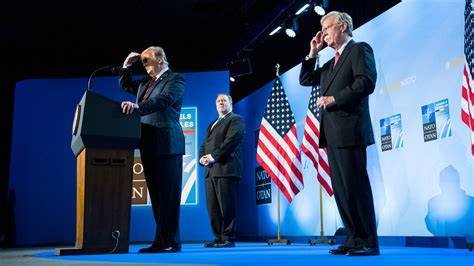
The most consequential rupture in Western alliance history may be unfolding in real time. President Donald Trump confirmed Wednesday that he is actively considering withdrawing the United States from NATO, calling the 77-year-old military alliance a “paper tiger” and declaring that an American exit is now “beyond reconsideration.”
Speaking to The Daily Telegraph, Trump said he was “never swayed by NATO” and that Russian President Vladimir Putin shares his view of the alliance’s weakness. He doubled down in a separate interview with Reuters, saying he was “absolutely” considering the move and previewing that he would voice his “disgust” with NATO during his primetime address to the nation.
The flashpoint is the US-Israeli war against Iran, now in its second month. Trump has been furious that NATO allies, including the United Kingdom, France, and Germany, declined to participate in military operations and refused to allow American aircraft to use their bases for strikes on Iranian targets. Several member states also declined to help enforce freedom of navigation in the Strait of Hormuz.
“They haven’t been friends when we needed them,” Trump told Reuters. “We’ve never asked them for much. It’s a one-way street.”
The threat has sent shockwaves across Europe. Polish Defense Minister Wladyslaw Kosiniak-Kamysz called Trump’s remarks “reckless and dangerous.” Estonian Foreign Minister Margus Tsahkna described any threat to the alliance as “harmful.” UK Prime Minister Keir Starmer, singled out by Trump for his refusal to commit the Royal Navy to the Iran campaign, reaffirmed that NATO remains “the single most effective military alliance the world has ever seen.”
There is a significant legal obstacle standing between Trump’s rhetoric and action. Congress passed a law in 2023, co-sponsored by then-Senator Marco Rubio, now Secretary of State, requiring a two-thirds Senate supermajority or an act of Congress to authorize a NATO withdrawal. Trump has recently signaled he believes presidential authority allows him to bypass that legislation, setting up what legal experts say would be a swift and unprecedented Supreme Court battle.
Senate Minority Leader Chuck Schumer has already declared that the Senate “will not vote to leave NATO,” while Sen. Mark Warner called the threat “reckless” and an insult to allied soldiers who died fighting alongside American troops in Afghanistan.
Under the NATO treaty itself, a member state must file a formal notice of denunciation and wait one full year before membership officially ends, giving courts and Congress a window to intervene.
For Russia’s Vladimir Putin, who has long sought to fracture transatlantic unity, the moment is a windfall. Analysts warn that even the credible threat of American withdrawal weakens deterrence, scrambles European security planning, and emboldens adversaries from Moscow to Beijing.
The coming days will clarify whether Trump’s statements are negotiating pressure or the opening move of the most seismic foreign policy shift since the Cold War ended.