WARREN, Ohio. A decade ago, Donald Trump pulled a generation of blue-collar and union households out of the Democratic column in Ohio and helped turn a classic swing state into a Republican stronghold. Three weeks before the 3 November midterm elections, Democrats and labor leaders say some of those voters are looking again, and the numbers from early voting and recent polls suggest the contest is closer than the state’s recent history would predict.
Reuters reported from Warren on Wednesday that rising prices, the war with Iran and unease over the president’s rhetoric are prompting some working-class voters to reconsider. Ohio’s political reputation had faded after 2016, when Trump won strong support from voters who felt their economic worries were finally being heard. The state backed the eventual winner in 14 straight presidential elections from 1964 through 2016, then backed Trump again in 2020 even as Joe Biden won nationally. Trump won it by 11 points in 2024.
The mood in some union halls and living rooms is more uncertain than it was. One voter identified in the Reuters report as Ringold said he supported Trump in 2016, Biden in 2020 and Trump again in 2024, and is now undecided on the Senate, governor and other races. “I’m in the wilderness trying to find a place,” he said. He pointed to higher fuel and food prices, describing inflation with the words “God knows we didn’t vote for this,” and added that he wishes the president would tone down his combative style. Several other voters interviewed by the news agency raised similar concerns.
Labor leaders offered a more structural critique. Jose Arroyo, a United Steelworkers official who handles contract negotiations, argued that Trump has succeeded in focusing attention on social issues with union members rather than on pay and conditions. Tim Burga, president of the Ohio AFL-CIO, criticised the administration’s changes at the National Labor Relations Board, which he described as a “dismantling” that has made it harder for unions to organise, contest unfair labour practices and win contracts. Union leaders also blamed federal workforce cuts for hurting local families, according to coverage of the report.
Early voting offers one early signal, though a limited one. In Trumbull County, which includes Warren and sits in the industrial northeast, 1,224 Democrats, 559 Republicans and 453 voters with no known party affiliation cast ballots during the first three days. Early turnout does not predict final results, because parties differ in how much they encourage voting before election day, but Democrats appeared more motivated than Republicans at the start.
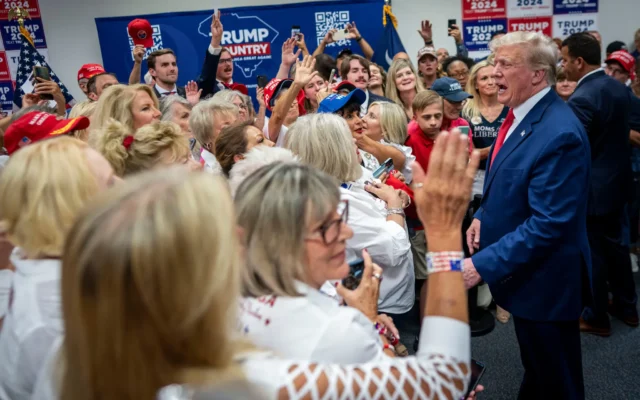
The stakes are significant. Republicans are defending a U.S. Senate seat and the governor’s office in Ohio, and two U.S. House races are rated toss-ups, one in the northwest that has long been held by a Democrat and one in the northeast held by a Republican. In the Senate special election, Republican Jon Husted, who was appointed to the seat in 2025, faces Democratic former senator Sherrod Brown, who lost to Bernie Moreno in 2024 by about three points. For governor, Democrat Amy Acton is challenging Republican Vivek Ramaswamy for an open seat. Trump is not on the ballot, but he has told supporters to act as if he is, and he has campaigned in the state twice in recent weeks, including at a rally in Youngstown on Monday alongside Husted and Ramaswamy.
Polling points to a tight race with a lean toward Democrats, though results vary. A Marist survey of registered voters published on 29 September found Brown ahead of Husted 51 percent to 43 percent. It also found 56 percent disapproving of Trump’s job performance against 42 percent approving, with half of respondents saying they strongly disapprove. A New York Times/Siena College poll of 616 likely voters had Brown ahead 49 percent to 46 percent and Acton ahead of Ramaswamy 49 percent to 45 percent, both within the margin of error. A Suffolk University/USA Today Network poll released on 1 October showed Brown up 46 percent to 44 percent. Newsweek reported that polling averages as of early October put Brown ahead by about three points in the Senate race and Acton ahead by nearly four in the governor’s race, while also noting that recent surveys have produced sharply different results and that Trump can point to at least one favourable poll. The president’s national approval rating has also dipped to a record low of 37 percent in one Wall Street Journal poll.
Those margins should be read cautiously. Brown trailed in 2024 even as Democrats hoped for an upset, and Ohio polls have missed before. Even a lead of a few points sits inside most surveys’ margins of error, and a small shift in who turns out could decide a race this close.
Not every worker is drifting. Reuters stressed that Ohio voters remain divided, and plenty of blue-collar Ohioans still back Trump because of his positions on immigration and border security, social issues and the value of their retirement savings. Husted has leaned into the president’s popularity with his base rather than distancing himself from it. Speaking before the Vandalia rally, he pointed to Trump’s 11-point win in Ohio two years ago and said he believes the president can motivate many people to vote. Some building trades unions that once backed Brown have endorsed Husted, while others, such as the plumbers and pipefitters and the regional carpenters’ council, have split their endorsements by backing Ramaswamy for governor but Brown for Senate, according to reporting from earlier in the campaign.
Paul Sracic, an Ohio-based senior fellow at the right-of-centre Hudson Institute, told Reuters that for working-class voters who are moving away from Trump, Brown offers a safe landing spot because of his populist record. That description shows why Democrats see the former senator as their best vehicle. Brown has spent years building a reputation on trade and labour issues, and he is leaning heavily on ties to union and blue-collar voters.
What happens in the closing weeks will depend on whether the economic discontent that voters describe hardens into a vote or fades back toward party habit. Prices for fuel and food, developments in the Iran war and the final stretch of campaign appearances could all matter. So could turnout among newer and less-engaged voters, who often decide close races in states like Ohio. Readers who follow how polling and data analysis shape modern campaigns can find related coverage at Innovation Times.