Fewer than four weeks before Americans vote, a simple question is getting an uneven answer from the people running for the US Senate: will you accept the result? A Reuters survey of campaigns in the 13 most competitive states found that a little over half said yes without conditions. The rest hedged, deflected or did not reply, a split that shows how unsettled the country’s election politics remain nearly six years after Donald Trump tried to overturn his 2020 loss.
Reuters put the question to the Republican and Democratic campaigns in 13 states that could decide control of the Senate, which Republicans now hold 53 to 47. Of the 26 campaigns contacted, 14 said their candidate would accept the outcome with no strings attached. Nine of those were Democratic, four were Republican and one was an independent. Most of the replies came by email or text message, though some candidates answered in person. The agency also asked about the possibility that the Trump administration could interfere in the voting, a topic that fewer campaigns were willing to address.
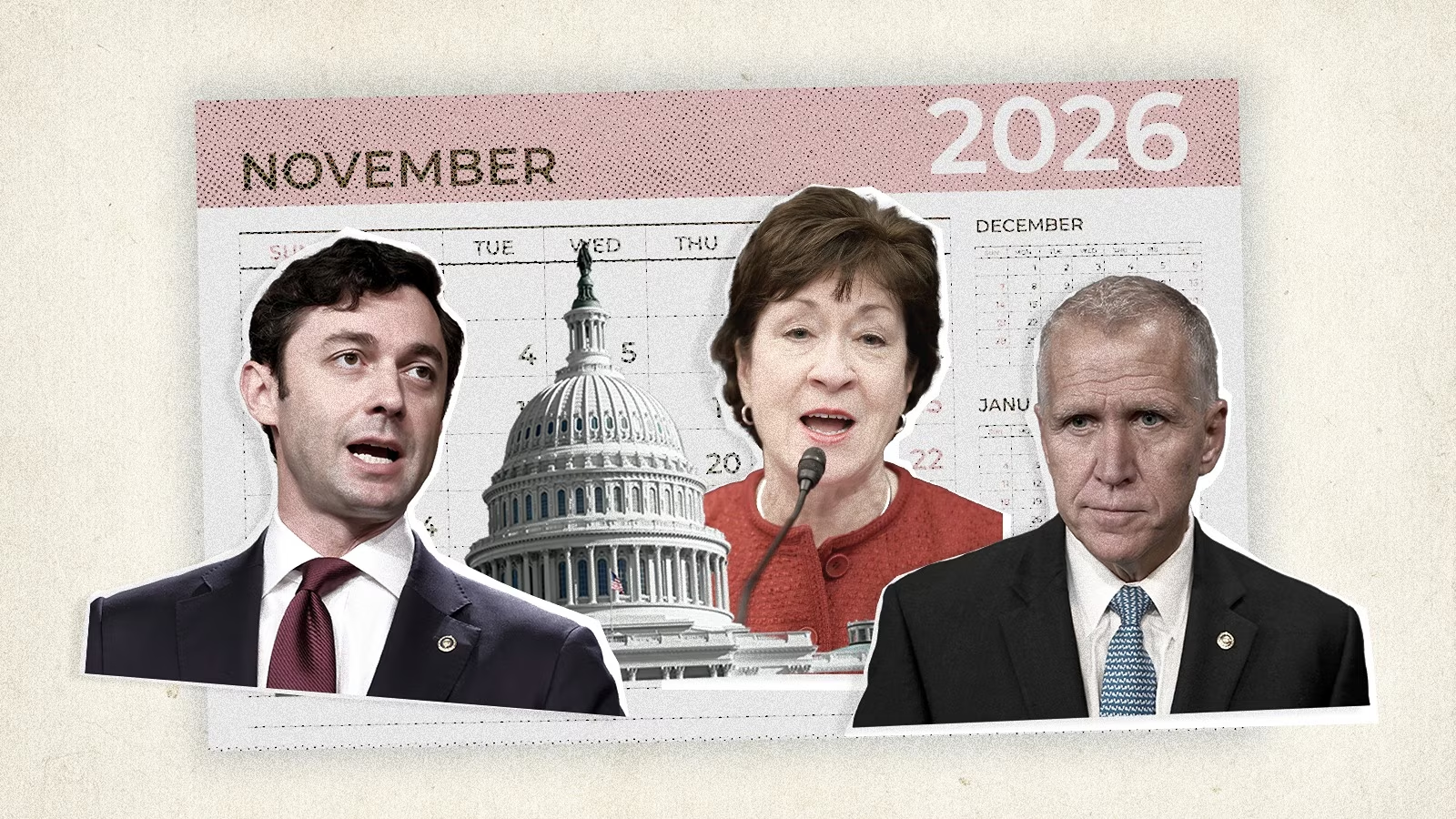
The clearest agreement came in Alaska, Iowa, Maine and New Hampshire, where both parties’ campaigns said they would accept the results without qualification. In Maine, Republican Senator Susan Collins went further than her party colleagues anywhere else in the survey. Hers was the only Republican campaign to speak to the intervention question, saying she would oppose any attempt to undermine the outcome of free and fair elections in her state and across the country.
A second group of races showed a consistent pattern in which Democrats offered a plain yes and Republicans answered conditionally or not at all. That was the case in Kansas, Michigan, Nebraska, Ohio and South Carolina. In Michigan, Democrat Abdul El-Sayed said he believes in democracy and would accept the result whatever it was. The campaign of his Republican opponent, Mike Rogers, answered that the question was a hypothetical because Rogers expects to win on 3 November. In Nebraska, independent Dan Osborn’s campaign said he would absolutely accept the outcome, while Republican Senator Pete Ricketts’s campaign replied that Nebraska’s elections are free and fair and that the senator plans to win. In South Carolina, Democrat Annie Andrews said she would accept the result, and the campaign of Republican Senator Darline Graham said only that she is taking nothing for granted.
Ohio produced one of the more revealing exchanges. Democrat Sherrod Brown’s campaign said he would accept the result. Republican Senator Jon Husted, a former Ohio secretary of state, gave a qualified answer, saying he would accept “any certified election that is run well.” When a reporter pressed him on possible federal intervention, he cut the question off, said he has great confidence in Ohio’s system and suggested that other parts of the country have weaker ones.
In Kansas, Republican Senator Roger Marshall, who is facing an unexpectedly competitive challenge from Democrat Adam Hamilton, called the intervention question a hypothetical and said he had not given it any thought. Marshall was one of eight Republican senators who voted against certifying Joe Biden’s 2020 victory. He told Reuters he is comfortable with Kansas’s voter integrity because the state has a voter identification law, and he voiced concern about mail-in voting nationally, but his campaign did not answer whether he would accept the final result. Hamilton’s campaign said he would absolutely accept it regardless of who wins.
Four states yielded no answer from at least one side. In Georgia, North Carolina, Minnesota and Texas, a campaign did not respond, and the reasons were not clear. In Georgia, Democratic Senator Jon Ossoff’s campaign said it expects a fair election but pledged to bring its full legal resources to bear against any credible interference from the Trump administration or anyone else. His Republican rival, Mike Collins, did not respond to repeated queries. In North Carolina, Democrat Roy Cooper’s campaign said he would accept the result once the lawful counting process is complete and pointed to new state voting restrictions as a reason to make sure every vote is counted. His Republican opponent, Michael Whatley, did not reply. Whatley helped lead Trump’s 2024 effort to challenge state election systems while serving as Republican National Committee chairman. In Texas, neither Democrat James Talarico nor Republican Ken Paxton responded.
The survey also shows that Democrats are not simply offering unqualified assurances. Ossoff’s and Cooper’s campaigns attached conditions about interference and lawful counting, and some Democrats criticized Republican-backed voting restrictions while stressing that all eligible votes must be counted. Some Republicans, for their part, accused Democrats of eroding public trust in elections. The disagreement, in other words, is partly about who is seen as the greater threat to confidence in the system.
The White House said Trump has done more than any other president to ensure free and fair elections, according to spokesperson Lauren Bis. She pointed to his demands for voter ID and proof of citizenship, steps Congress has not enacted, and said anyone who illegally votes will be held accountable. Reuters reported that Trump has repeatedly sought to federalize state-run elections, to gain access to state voter registration rolls and voting records, and to accuse Democrats of voter fraud without evidence. State and local election officials are preparing for the chance of administration intervention.
Public confidence provides a different picture from the politicians’ hedging. A Reuters/Ipsos poll conducted from 30 September to 5 October found that 76 percent of registered voters are confident their ballots will be counted accurately, up from 69 percent in 2022. Reuters said the increase was driven largely by Republicans, which echoes earlier research suggesting that voters’ trust often tracks whether their side expects to win.
The political stakes explain why the question matters so much this year. Trump’s record-low approval rating, along with high energy and consumer prices linked to tariffs and the war with Iran, have put Republicans on the defensive even in states that normally lean their way, and independent analysts consider Democrats favoured to win the House. Races such as Ohio, where polls show Brown and Husted separated by only a few points, could determine the chamber. Close results tend to bring recounts, lawsuits and disputes over certification, and a candidate’s pre-election position on accepting the outcome can shape how that period unfolds.
A pledge to accept results is a modest promise, and it does not stop a candidate from seeking a recount or filing a lawful challenge. What the survey measures is willingness to say so in advance. On that narrow test, roughly half of the contenders said yes without hesitation, and the other half left some room. Readers following how voting data and digital systems affect election security can find related coverage at Innovation Times.