
Published: May 6, 2026 | By Innovation Times Technology Desk
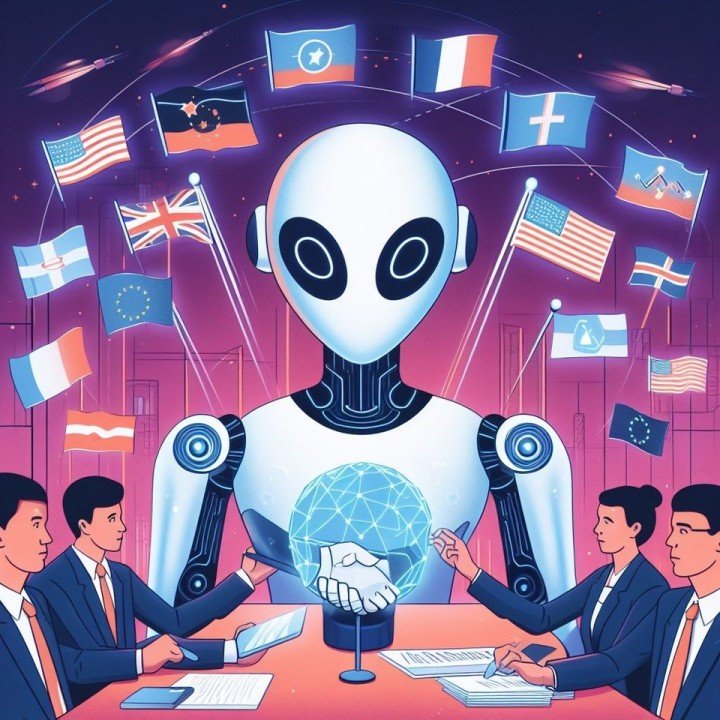
AI governance has become the defining policy battleground of 2026, with the United States and the European Union charting fundamentally different courses that could reshape global technology competition for decades. While Washington bets on innovation supremacy through deregulation and massive infrastructure investment, Brussels pushes forward with the world’s most comprehensive AI rulebook. The divergence is not merely philosophical. It carries trillion-dollar consequences for tech companies, governments, and billions of users worldwide.
The EU AI Act, which became law in August 2024, continues its phased rollout this year. From August 2, 2026, companies operating in the European Union must comply with specific transparency requirements and new obligations for high-risk AI systems embedded in regulated products. The European Commission released new guidance in April 2026, making 63.2 million euros available specifically for AI innovation in health and online safety sectors, signaling that Brussels wants compliance and competitiveness to coexist.
The United States is moving in a starkly different direction. The Trump administration’s AI Action Plan, backed by a series of executive orders, aims to strip away what officials call regulatory red tape and position American companies at the front of what the White House describes as a generational race against China. Federal agencies are already deploying AI tools at scale, with nearly 90% of federal departments either using or planning to use artificial intelligence systems this year. The State Department has even released its own AI strategy, equipping diplomats with real-time AI decision-making tools.
Private investment tells the clearest story. Industry analysts estimate that hyperscaler companies, the giant cloud and AI infrastructure firms, will collectively spend $527 billion globally in 2026. OpenAI’s leadership has flagged that training a single frontier AI model could require $100 billion in capital within this decade. Against that scale, the EU’s enforcement budget of roughly $1 billion looks almost symbolic, though EU officials argue that rule-setting, not spending, is where Europe’s leverage lies.
The race is not limited to the US and Europe. China’s AI investment grew by 48% to $98 billion in 2025, and Beijing is pushing its companies to innovate through more open models while applying nationwide transparency regulations that require greater disclosure than their American counterparts. The contrast creates a paradox: China regulates more heavily on transparency while the US regulates less heavily overall, yet both claim their approach will win the AI race.
Colorado’s AI Act, currently set to take effect on June 30, 2026, will become America’s most substantive state-level AI law, placing obligations on developers and deployers of high-risk AI systems regarding algorithmic discrimination, risk management, and impact assessments. California has already enacted a wave of transparency and whistleblower protection bills. State attorneys general across the country are ramping up enforcement scrutiny of AI systems, creating a patchwork regulatory environment that large corporations increasingly struggle to navigate.
Read More: Africa’s AI Revolution Could Add $1 Trillion to GDP by 2035, African Development Bank Report Warns That Action Must Start Now
For businesses, the cost of compliance is rising fast. Gartner projects that global spending on AI governance platforms will reach $492 million in 2026 and exceed $1 billion by 2030. The consultancy warns that by 2030, fragmented AI regulation could quadruple, eventually covering 75% of the world’s economies. Companies operating across multiple jurisdictions face the growing burden of satisfying different, and sometimes contradictory, regulatory requirements simultaneously.
The deeper question is whether any global coordination is possible. At recent international AI summits, the US and UK declined to sign declarations promoting inclusive and sustainable AI governance, while 60 other nations endorsed shared principles. Critics warn that without coordination, the world risks an AI governance race to the bottom, where countries compete by offering the lightest regulatory touch. Supporters of the US approach argue that the greater risk is regulatory overreach that hands China a competitive advantage. As AI systems move from experimentation to mass enterprise adoption, the policy choices made in the next 12 months will define the rules of the digital economy for years to come.