
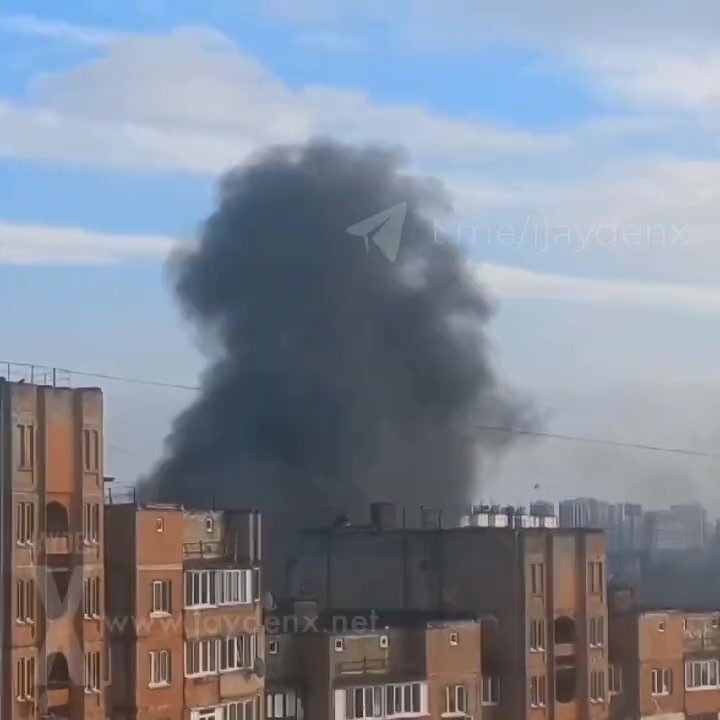
Ukraine launched its largest drone offensive on Russian territory in months early Sunday morning, sending more than 556 drones deep into Russian airspace and killing at least four people, including three near the Russian capital Moscow. The audacious overnight strike hit residential buildings in Khimki, Krasnogorsk, and Istra towns that ring Moscow and sent debris crashing onto the grounds of Sheremetyevo Airport, Russia’s busiest international hub. No injuries at the airport were reported, but the strike’s proximity to a major civilian facility marks a serious and alarming escalation in the three-year-old war.
Ukrainian President Volodymyr Zelenskyy confirmed the operation in a statement posted to his official Telegram channel, calling the strikes “entirely justified.” He pointed directly to Russia’s own aerial campaign against Ukraine as the trigger. “Our responses to Russia’s prolongation of the war and attacks on our cities and communities are entirely justified,” Zelenskyy said. “This time, Ukrainian long-distance sanctions have reached the Moscow region, and we are clearly telling the Russians: their state must end its war.”
Russia’s Defense Ministry acknowledged the attack, saying its air defenses intercepted 556 Ukrainian drones overnight. Moscow Mayor Sergei Sobyanin confirmed that more than 120 drones targeting Moscow and its surrounding areas were shot down. Despite that defensive effort, the sheer volume of projectiles overwhelmed portions of Russia’s air defense network and allowed multiple drones to strike civilian structures. A woman died after a drone hit a private home in Khimki. Russian state news agency TASS confirmed the deaths and reported that a house in the village of Subbotino caught fire after falling drone debris ignited it.
This attack follows one of the deadliest Russian strikes on Kyiv in the entire war, which unfolded just days earlier. Russia launched more than 1,560 drones at Ukraine across a 36-hour window that began Wednesday, according to Zelenskyy, making it the single largest aerial assault in a two-day period since Russia began its full-scale invasion in February 2022. That strike hit six districts of Kyiv, killed at least 25 civilians, injured dozens more, and destroyed a nine-story apartment block. Two children were among those killed. A power substation and high-voltage line serving Kyiv were also knocked out, plunging parts of the capital into darkness.
The drone war has now taken on a deeply strategic dimension beyond the battlefield. Ukraine has been deliberately targeting Russian oil refineries and fuel infrastructure with long-range drone strikes, aiming to slash Moscow’s petroleum export revenues, which fund the war machine. Drones striking oil facilities inside Russia have generated massive fire columns visible from space and caused toxic fallout over Black Sea tourist regions. The economic impact remains difficult to measure precisely, because a surge in global oil prices linked to the separate Iran-US standoff in the Strait of Hormuz has helped offset some Russian revenue losses.
Defense analysts monitoring the conflict say Ukraine’s ability to launch mass drone offensives deep into Russian territory is reshaping the psychological and political landscape inside Russia. “It brings home the fact that Ukraine has the capacity to strike at very significant scale at or around the Russian capital,” Nigel Gould-Davies, a senior fellow at the International Institute for Strategic Studies, told the Associated Press. He added that the strikes are adding to “the darkening cloud of anxiety over Russia,” amplifying pressure on the Kremlin from Russian citizens who had previously felt insulated from the war’s consequences.
Read More: Trump Immigration Crackdown Is Shrinking the U.S. Workforce by 2.4 Million Workers and Threatening AI Dominance
The escalation comes at a deeply sensitive diplomatic moment. US President Donald Trump recently brokered a three-day ceasefire between Kyiv and Moscow, timed to allow Russia to hold its Victory Day parade on May 9 commemorating the Soviet Union’s World War II victory. That fragile truce collapsed almost immediately, with both sides accusing the other of violations. Trump departed Beijing last week following a summit with Chinese President Xi Jinping without securing firm agreements on Ukraine, Iran, or the Strait of Hormuz, leaving the conflict’s diplomatic track at a dead standstill.
With no peace process functioning and both sides escalating aerial campaigns to historic intensity, international observers warn the war risks entering a phase in which drone technology determines the strategic balance rather than traditional military lines. Ukraine has shown it can produce and deploy drones at industrial scale. Russia continues to absorb those strikes while hammering Ukrainian cities. For civilians on both sides, the suffering has no visible end.