
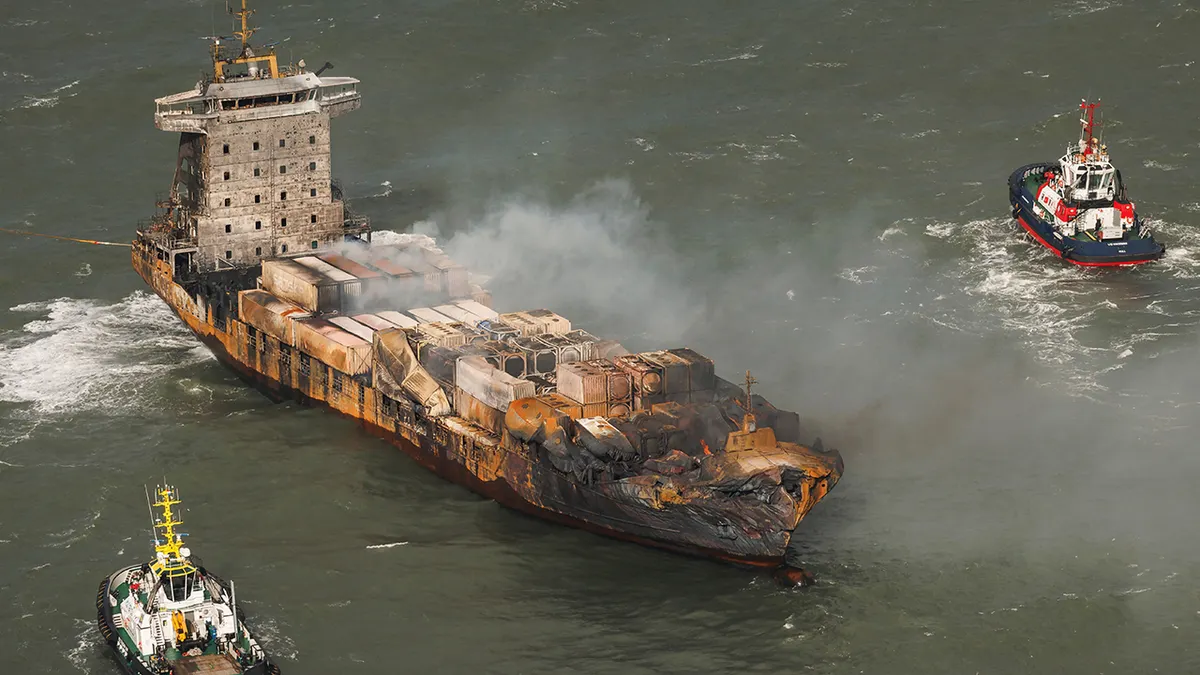
Two Cargo Ships Hit by Drones Off Bulgaria in Black Sea Attack as One Sinks and 11 Sailors Remain Missing
Eleven sailors remained missing on Tuesday after drones struck two cargo ships off Bulgaria’s Black Sea coast overnight, sinking one vessel and damaging the other, according to Bulgarian officials. It was the second deadly strike on merchant shipping in Bulgarian waters in a week. It also arrives while the marine insurance market is already repricing risk across the whole basin.
Prime Minister Rumen Radev said the first distress call reached authorities at about 1.30 am local time. It concerned the Chelsea 3, a general cargo ship owned by a Ukrainian company and sailing under the Maltese flag. The vessel was hit by three aerial drones roughly 33 kilometres off the coastal town of Byala. All 15 crew members, seven Ukrainians and eight Azerbaijanis, were rescued, and no serious injuries were reported.
Soon afterwards a second merchant ship was struck farther north and went down about 17 nautical miles east of the village of Krapets. President Iliana Iotova identified it as the Guinea-Bissau-flagged HS Dignity, although Bulgarian media have also used the name Azov Concord. The name should be treated with some caution until the authorities settle the question. Rescue coordinators said five people were pulled from the water and 11 are missing. Casualty counts have shifted slightly between early reports, which is common in the first hours of a maritime emergency.
Radev called the incidents “absolutely unacceptable” and said he would summon Russia’s ambassador and speak with NATO Secretary General Mark Rutte. Sofia also asked for help from the European Union and from NATO, which Bulgaria joined in 2004. Russian Ambassador Eleonora Mitrofanova attended talks in Sofia and told reporters she had received no information from Moscow’s defence ministry about attacks on commercial vessels in the Black Sea.
Bulgaria has stopped short of formally naming Russia as the attacker. Ukraine has not been so careful. Foreign Minister Andrii Sybiha blamed Moscow and accused it of deliberately disregarding civilian lives and maritime security. He argued that the sea is a lifeline for global food security. Russia, for its part, has not claimed responsibility for the strikes.
The pattern behind Tuesday’s attack is hard to miss. On October 6, two commercial vessels were hit in Bulgaria’s exclusive economic zone. One of them, the Alfa Watan, sank, and its 10 crew members, nine Syrians and one Egyptian, are still missing. The crew of the second ship was rescued and brought ashore at Varna. That incident led President Iotova to convene the Consultative Council for National Security, though Bulgarian officials said at the time that the circumstances were unclear. The day before, another vessel caught fire and sank off the Romanian coast, killing one person and leaving another missing. Ukrainian President Volodymyr Zelenskyy said Russian drones were responsible.
Taken together, the incidents mark a shift in the geography of the war at sea. For much of the conflict, the highest-risk waters sat close to Ukrainian and Russian ports. Strikes near the coasts of two NATO and EU members, Bulgaria and Romania, pull the danger into waters that carry grain, crude oil and refined products toward European and Turkish buyers. Russia’s full-scale invasion of Ukraine is now in its fifth year, and both sides have stepped up attacks on each other’s commercial shipping over the past two months. Ukraine and its European allies say Moscow is hitting merchant vessels that carry civilian cargo, including grain.
For markets, the first place the damage shows up is insurance. In mid-September, the Joint War Committee, a body of underwriters from the Lloyd’s Market Association and the wider London market, widened its Black Sea listed area. Reporting requirements now apply to the whole sea, where before only the coastal waters of Russia and Ukraine were covered. Reuters reported at the time that war risk premiums were adding hundreds of thousands of dollars to the cost of each seven-day voyage after dozens of ships had been attacked in recent weeks.
The numbers vary by route and cargo, but the direction is consistent. One shipping analysis put premiums for Black Sea port calls at around 1% of a vessel’s insured value, up from roughly 0.6% to 0.8% in late December. It also noted that routes which once sat outside the war risk area now cross it, which can trigger additional premiums and notification duties for owners. Platts assessments show a similar story for crude. The additional war risk premium on Black Sea oil shipments climbed from $2 a barrel in mid-July to $3.70 by the end of that month, then eased to $2.90 by September 30. That is still well above where it began, and Tuesday’s attacks make a further retreat less likely.
Insurers have also changed how they price. Market sources told Reuters earlier this year that underwriters were reviewing cover terms daily rather than every 48 hours, and that cancelling cover altogether remained an option, though there was no sign of it then. Some shipowners are also expected to weigh crew bonuses for transits through the listed area. That matters because the human cost of these attacks lands on seafarers, many of whom come from countries with no stake in the war. The latest missing include Syrian and Egyptian nationals from last week’s incident, and the crews aboard Tuesday’s ships came from Ukraine and Azerbaijan.
Commercial consequences ripple outward. Higher premiums are paid by charterers and cargo owners, and they typically feed into freight rates and, eventually, the delivered price of grain, fuel and other bulk goods. Smaller operators, especially those running older tonnage on short Danube and coastal routes, have the least room to absorb a rise. They also face the question of whether a cargo is worth the risk at all. Larger operators can usually pass costs along, but they must now plan around the chance that a vessel is lost at sea, along with its crew.
Several things will shape the days ahead. The first is the search for the 11 missing sailors, which remains the immediate priority for Bulgarian rescue services. The second is what Sofia does diplomatically. Summoning an ambassador is a recognised step, but how far Bulgaria goes in attributing the attacks will influence what NATO and EU partners are prepared to do. The third is the response from underwriters. Any further widening of the listed area or another jump in premiums would show how the market reads the risk near the Bulgarian and Romanian coasts. Analysts have noted that the high-risk zone could expand if incidents move closer to Turkish waters, which would affect still more routes.
Bulgarian authorities have not published a full account of how the two ships were attacked, and independent verification of who launched the drones is still pending. What is established is that two merchant vessels were hit within hours of each other off a NATO member’s coast, one is on the seabed, and 11 people have not been found. More market and technology coverage is available at Innovation Times.