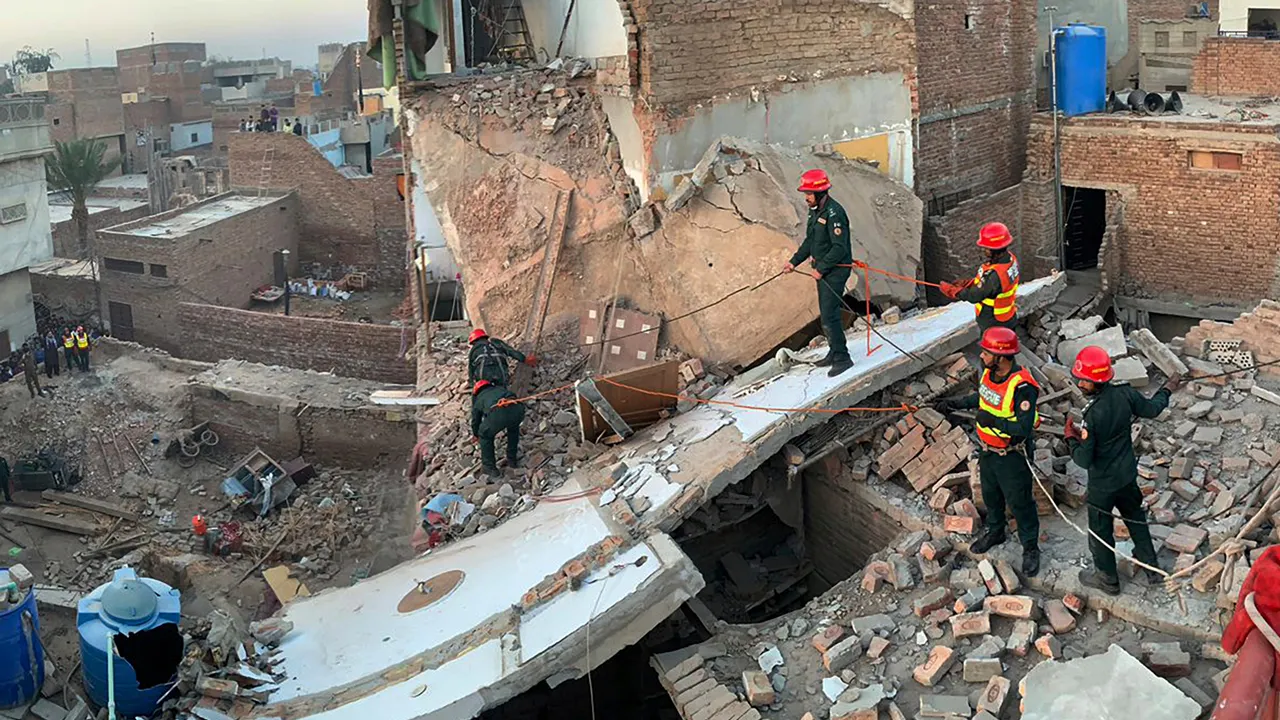
At least 29 people, including children and a teacher, have died after the roof of a private school collapsed in Peshawar, northwestern Pakistan, on Thursday, October 15, 2026, prompting an investigation into building safety and the arrest of the school’s owner.
The disaster occurred at Al-Khair School in Peshawar, the capital of Khyber Pakhtunkhwa province, while pupils were attending classes. The collapse left dozens injured and triggered an emergency response as rescue workers, local residents and medical teams worked to reach victims trapped beneath the debris.
The death toll and casualty breakdown have varied across early reports as authorities received information from hospitals and rescue teams. The Associated Press reported at least 29 deaths, including 28 children aged 13 or younger and a teacher. More than 50 people were reported injured, with some requiring urgent medical attention.
Police confirmed that the school’s owner had been arrested as investigators began examining the circumstances surrounding the collapse. Authorities have yet to establish a final, official account of what caused the structure to fail.
The incident has renewed concern about the safety of school buildings in Pakistan, particularly in densely populated urban neighbourhoods where authorities face challenges enforcing construction standards and ensuring that buildings used for education are structurally sound.
The tragedy also raises urgent questions about whether children are being adequately protected in the places where they are expected to learn.
The school was operating in a three-storey building in a congested part of Peshawar. Initial reports indicated that the structure was weak, although the precise sequence of events that led to the collapse remains subject to investigation.
As news of the disaster spread, families rushed to establish whether their children were among the dead, injured or missing. Emergency personnel transported casualties to Lady Reading Hospital, a major public hospital in the city, where medical staff responded to the influx of patients.
The hospital declared an emergency to support the treatment of victims. Some of the injured were reported to be in critical condition, adding to concerns that the human cost of the collapse could increase as medical assessments continued.
The presence of young children among the victims has intensified the grief surrounding the incident. For parents, teachers and members of the surrounding community, the collapse transformed an ordinary school day into a devastating emergency.
Rescue workers faced the immediate challenge of clearing debris while attempting to reach anyone who might still be trapped. Residents also joined the response, helping emergency teams at the scene.
The operation required careful handling of the damaged structure, as additional movement of unstable building materials could put both survivors and rescuers at risk. Authorities were also responsible for coordinating medical transport and identifying victims.
The arrest of the school’s owner marks an important development in the investigation, but it does not by itself establish criminal responsibility. Investigators will need to determine whether the building complied with relevant construction requirements, whether the school had the necessary permissions to operate from the premises and whether any identifiable safety failures contributed to the collapse.
Police have indicated that the building was structurally weak. Investigators are expected to examine the construction, the condition of the roof and the building’s suitability for accommodating students.
Any findings about negligence, unauthorised construction or the use of unsuitable materials will need to be supported by evidence gathered during the inquiry. The investigation should also establish whether inspections were conducted and whether authorities had previously received complaints about the premises.
These questions matter because accountability extends beyond identifying who owned the property. A thorough investigation must establish how the building was designed, constructed, maintained and approved for educational use.
The school roof collapse comes amid wider concerns about building safety in Pakistan, where deadly structural failures have repeatedly exposed weaknesses in construction practices and regulatory enforcement.
In June 2026, a roof collapse at a tutoring centre under construction in Lahore killed at least 14 children and injured others. That incident prompted further concern about the risks posed by unsafe educational facilities and the need for effective oversight.
The Peshawar disaster adds to those concerns and places renewed pressure on officials to examine whether existing safety checks are adequate.
Schools carry a particular responsibility because children have little control over the physical conditions of the buildings they attend. Parents depend on school operators and public authorities to ensure that classrooms, stairways, roofs and other facilities are safe for daily use.
When a building fails, the consequences can be severe, especially where several classrooms occupy a structure that was not designed or maintained for the number of people using it.
Overcrowding can increase the risks associated with inadequate facilities, but it would be premature to identify it as the cause of this collapse without the results of a technical investigation. Establishing whether the building was overloaded, improperly modified or weakened by construction defects will be essential to understanding what happened.
The inquiry also presents an opportunity to review how educational institutions are monitored. Inspections are most effective when they identify hazards before a building becomes dangerous, rather than after a fatal incident has occurred.
That requires clear construction standards, reliable inspection procedures, accurate records and consequences for serious violations. It also requires coordination between school regulators, local authorities, building inspectors and emergency services.
Private schools play an important role in providing education to families across Pakistan. However, private ownership does not remove the need for buildings to meet safety requirements. Every institution that accommodates children should be able to demonstrate that its premises are suitable for that purpose.
For authorities, the immediate priorities are to establish the full casualty count, support injured victims and their families, identify the cause of the collapse and determine whether further action is necessary against those responsible.
Families affected by the disaster will also need clear information about the identification of victims, medical treatment for survivors and the findings of the investigation. Transparent communication can help prevent uncertainty from adding to the distress already experienced by the community.
Officials must also consider whether other school buildings in the area require urgent inspections. If investigators identify a specific structural defect or unsafe construction practice, a wider review could help establish whether similar risks exist elsewhere.
Such a review would be especially important if buildings have been converted from residential use into schools without adequate assessment of their structural capacity, exits, classroom arrangements or emergency access.
The tragedy illustrates why building safety cannot be treated as a paperwork exercise. A licence or registration document alone cannot guarantee that a structure remains safe. Regular physical inspections and timely repairs are necessary to ensure that buildings continue to meet the needs of the people inside them.
For readers following developments in international affairs, the incident is also a reminder that disasters affecting schools have consequences far beyond the immediate location. They disrupt families, place pressure on public hospitals, unsettle communities and raise broader questions about public safety and institutional responsibility.
Further updates from Pakistani authorities are likely to clarify the final number of victims and the evidence collected during the investigation. Until those findings are released, the cause of the collapse should be treated as unconfirmed, and allegations of negligence should be distinguished from conclusions established by investigators or a court.
The most urgent task remains supporting those affected and ensuring that survivors receive appropriate medical care. The next is to establish how a school building could collapse during classes and whether the disaster could have been prevented.
The deaths in Peshawar have left families grieving and a community demanding answers. The arrest of the school’s owner represents an early step in the response, but meaningful accountability will depend on a credible investigation and action based on its findings.
For Pakistan, the lasting test will be whether this tragedy leads to stronger enforcement of building safety standards, more effective inspections and practical measures to protect students in schools across the country.
Innovation Times will continue covering major developments in international news, public safety and other stories with global significance.