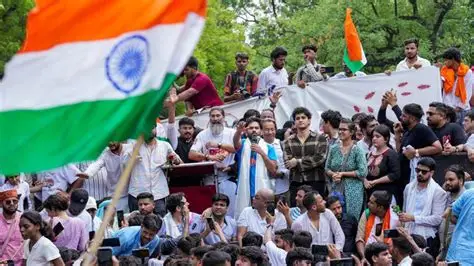
NEW DELHI. Police detained the leaders of India’s youth-led “Cockroach” movement as they landed in the capital on Saturday, then freed them within hours as a court intervened, in the sharpest confrontation yet over a nationwide revision of voter lists. The dispute has pulled opposition parties, student groups and a fast-growing online movement into the same demand: that Chief Election Commissioner Gyanesh Kumar step down.
The detentions took place on 10 October. Abhijeet Dipke, founder of the Cockroach Janta Party, along with senior leaders Saurav Das and Ashutosh Ranka, were expected to anchor a mass rally at Jantar Mantar in central Delhi. Police boarded their flight from Mumbai after it touched down and took them into custody before they could reach the protest site. A New Delhi court ordered their release after they were produced before a magistrate early the next morning, their lawyers said. By Sunday they were speaking to reporters at the Press Club of India and promising to keep up the pressure.
The capital looked very different from a normal Saturday. Reuters reported that 45 metro stations and markets were shut, and mobile internet was suspended in the central business district. NPR described a sweeping security operation in which thousands of protesters were detained, along with several movement leaders, opposition lawmakers and student activists who were stopped before they could arrive. Police gave no overall count of those held. Most detainees were released late that night, according to police. Social media personality Dhruv Rathee, who was among those held, was freed after midnight on condition that he stay away from further protests, an interior ministry official who did not wish to be named told reporters.
The Cockroach movement is a young force in Indian politics. According to the Associated Press, it began as an online satirical campaign this summer after the country’s chief justice compared unemployed young people to parasites. The group turned that insult into a rallying identity and moved quickly from memes to street action. In July, supporters scuffled with police while trying to march toward Parliament to demand the resignation of the education minister. The voter list dispute, NPR noted, gives the movement a bigger platform to broaden its campaign beyond jobs and education. Its social media accounts now describe the election chief protests as “Season 2.”
At the center of the anger is the Special Intensive Revision, or SIR, of electoral rolls, an exercise that began last year and is now being carried out nationwide. Critics say it has stripped millions of eligible citizens of their right to vote and that the changes tilt the field toward Prime Minister Narendra Modi’s Bharatiya Janata Party, which has governed for more than 12 years. The Election Commission and the BJP reject that charge. The commission says the revision exists to remove duplicate, deceased or ineligible entries and to protect the integrity of the rolls.
The numbers behind the argument are large. Election Commission data cited by the Cockroach Janta Party shows about 130 million names deleted during the verification drive, including 63 million people who had moved away and 30 million who could not be traced. Al Jazeera reported that commission figures indicate voter rolls could shrink by as much as 30 percent in some regions. Deleting a name from a list is not the same as proving wrongdoing, and the commission’s position is that many removals reflect migration, deaths and duplicates. Protesters counter that people who have lived at the same address for years are among those who say they were dropped. Rim Jhim Sharma, a Delhi resident from the Soniya Vihar area, told Reuters before she was detained that many in her neighbourhood had lost their voting rights and that protesting was her right.
The youth movement is not acting alone. Opposition parties launched their own campaign days earlier. Congress workers protested in cities including Lucknow, where leaders chanted “vote chor” slogans and were taken away in buses before being released that evening. On Tuesday 6 October, Rahul Gandhi, his sister Priyanka Gandhi and Samajwadi Party chief Akhilesh Yadav were among the opposition lawmakers briefly detained when a march from Parliament toward the Election Commission headquarters was stopped by heavy police deployment. Congress president Mallikarjun Kharge called the commission a puppet in the government’s hands as the march began. A day later, Rahul Gandhi and Priyanka Gandhi were detained again while leading opposition MPs toward Jantar Mantar, and Gandhi told reporters he believed the election chief would have to resign. In Mumbai, Raj Thackeray and Uddhav Thackeray led protests calling for the revision to be scrapped.
Kumar has not responded publicly to the resignation demands or commented on the demonstrations, according to Reuters. The commission has taken one corrective step. Around the start of the protests, it directed officials to register eligible voters who had been inadvertently left off the rolls, an acknowledgment that mistakes are possible even as it defends the overall exercise. Police have also registered cases against some demonstrators for allegedly violating orders that ban mass gatherings in the capital, a detail that suggests the legal fallout may outlast the street action.
What makes the standoff significant goes beyond one official’s job. Voter rolls are the foundation of every Indian election, and public confidence in them is difficult to rebuild once it frays. The government and the commission say the revision is routine housekeeping on a vast scale. The opposition and the new youth movement say it amounts to quiet disenfranchisement. Independent verification of individual cases would be needed to settle those competing claims, and so far the public record consists largely of aggregate figures and accusations from both sides.
The policing choices also invite scrutiny. Shutting metro stations, cutting mobile data and detaining thousands before a rally starts are tactics that critics describe as heavy-handed, while authorities have pointed to the ban on mass gatherings. Courts will likely be asked to weigh in on both the detentions and the underlying revision. For now, the quick release of the movement’s leaders has handed the group a measure of momentum rather than silencing it.
Readers tracking how online mobilisation and digital tools are reshaping political movements can find related coverage at Innovation Times.