
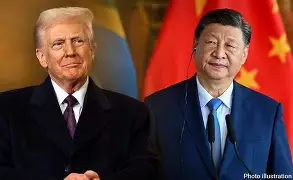
The world is watching Beijing this week as US President Donald Trump and Chinese President Xi Jinping sit down for what could be the most consequential diplomatic summit of the decade. The meeting, originally scheduled for March 2026, comes after months of diplomatic turbulence rooted in Washington’s military conflict with Iran, a war that has triggered what analysts now call the most severe global energy shock in modern history. Every government from Singapore to Brussels is tracking what comes out of this summit, and with good reason.
Trump and Xi meet at a moment when global oil prices have reached dangerous highs. Brent crude climbed past $104 per barrel this past Sunday, while US crude pushed close to $98.48 per barrel, driven by the closure of the Strait of Hormuz, the critical waterway through which nearly 20 percent of the world’s oil supply passes. Any breakthrough in Beijing that eases tensions around that waterway could offer near-term relief to global markets that have been hammering ordinary citizens with high fuel prices for months.
Before the main summit, senior economic officials from both nations met in South Korea. Chinese Vice Premier He Lifeng and US Treasury Secretary Scott Bessent sat down to discuss trade and economic issues. The preliminary talks aimed to prevent recent escalations, including US sanctions on Chinese refiners buying Iranian crude and Beijing’s countermeasures in response, from derailing any progress. Analysts at Teneo’s political risk advisory unit say the goal is to protect a fragile truce both sides reached in South Korea last year.
The stakes could not be higher. If Trump and Xi reach an energy deal in which Beijing agrees to buy more American oil and natural gas, global commodity prices could shift significantly. Matt Gertken, chief strategist at BCA Research, warns that any Chinese commitment to direct investment into the US economy could displace Japanese and European market share, creating new winners and losers among America’s allies. Europe and Japan are watching this summit not just as observers but as potential victims of any US-China bilateral deal.
Moscow is also paying very close attention. China’s economic and political support has become increasingly important to Russia during its war with Ukraine. Former US intelligence official Dennis Wilder, now a professor at Georgetown University, told journalists that Russia would grow nervous about any overall improvement in US-China relations. He added that one possible outcome of the summit could be a reduction in China’s support for Russia’s war effort in Ukraine, which would represent a dramatic geopolitical realignment.
Read More: US-Iran War Pushes Global Oil Prices Past $108 Per Barrel as Strait of Hormuz Crisis Enters Its 71st Day With No Peace Deal in Sight
Trump has already signaled that he wants Xi to visit Washington later this year, which would mark the Chinese president’s first trip to the US capital in ten years. That aspiration underscores how much both sides want to reset the relationship, even as deep tensions persist over Taiwan, trade imbalances, technology competition, and the Iran conflict.
For everyday people around the world, the most immediate outcome they want to see is lower energy prices. US Energy Secretary Chris Wright said this Sunday that the administration supports all measures to bring fuel costs down, including a possible suspension of the federal gas tax. He acknowledged that gas price relief depends heavily on whether the Strait of Hormuz reopens, a development that the Beijing summit could help advance.
The outcome of this summit will shape global trade, geopolitics, supply chains, and economic growth for the rest of 2026 and well beyond. Failure in Beijing means prolonged energy pain for billions of people. Success could reset the rules of global order. The next 48 hours matter enormously.