
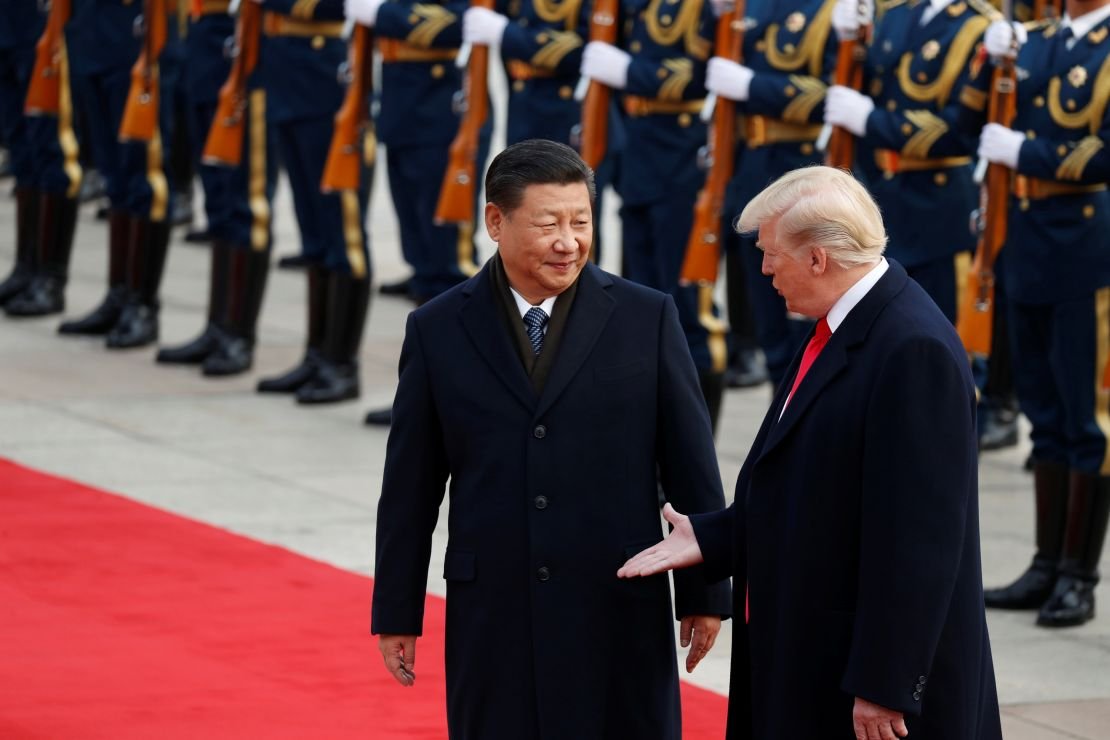
Trump boarded Air Force One Tuesday morning and headed to Beijing for what analysts are already calling one of the most consequential diplomatic meetings of this decade. The Trump-Xi summit, scheduled for Thursday and Friday at the Chinese capital, comes at a moment when the relationship between the world’s two largest economies sits on a knife-edge, strained by trade battles, the ongoing US war against Iran, China’s rare earth export restrictions, and the ever-present shadow of Taiwan.
The summit was originally set for March but was postponed after the United States became militarily embroiled in its conflict with Iran, an escalation that triggered what experts describe as the worst global energy shock in recorded history. Now, with the Strait of Hormuz still partially blocked by US and Iranian military forces, global oil markets remain in turmoil, and every outcome from this week’s Beijing talks carries enormous economic weight for the rest of the world.
Trump signaled his ambitions before departure, writing on Truth Social: “Great things will happen for both Countries!” The White House struck a more measured tone. Spokeswoman Anna Kelly told reporters the president’s chief goal is to continue “rebalancing the relationship with China and prioritizing reciprocity and fairness to restore American economic independence.”
Joining Trump on the trip is a delegation of America’s most powerful corporate executives. Tesla CEO Elon Musk, Apple CEO Tim Cook, BlackRock’s Larry Fink, and Boeing CEO Kelly Ortberg are all making the journey to Beijing. Boeing is hoping to break a years-long drought in Chinese aircraft orders. Ortberg signaled last month that China could soon place what he described as a “big number” order for commercial jets.
Trade and tariffs dominate the agenda. Washington and Beijing were locked in a bruising trade war throughout most of 2025, with Trump’s sweeping tariff policies drawing fierce Chinese retaliation. The Supreme Court struck down his most aggressive global “reciprocal” tariff package as unconstitutional in February, which gave both sides room to negotiate. Since then, US merchandise trade with China has fallen more than a third from 2017 levels, and neither side can afford for the relationship to collapse further.
Experts expect discussions to cover the creation of a bilateral trade management board, investment dispute mechanisms, and a potential Chinese commitment to purchase US soybeans, natural gas, and possibly additional agricultural goods. Citigroup CEO Jane Fraser, who is also attending, told Bloomberg that her company is already seeing renewed interest from Chinese investors.
Iran hangs heavily over every conversation. The Middle East war has caused fuel scarcity across Southeast Asia, rattled global supply chains, and forced governments from Singapore to Brussels to cut growth forecasts. One potential breakthrough that markets are watching closely is whether Trump and Xi can agree on a coordinated effort to reopen the Strait of Hormuz. Analysts caution that such an outcome remains unlikely in the short term, but even a signal of joint intent could ease energy prices significantly.
China’s decision to suspend exports of rare earth minerals and related magnets has also upended automotive supply chains across Europe, Japan, and South Korea. That restriction, along with Beijing’s ban on semiconductors from Nexperia China, will be on the table in Beijing. US officials have also accused China of running industrial-scale campaigns to steal American AI technology, a charge Beijing firmly denies.
Arthur Dong, a professor of strategy and economics at Georgetown University’s McDonough School of Business, told reporters the stakes are extraordinarily high. “Virtually everyone has a stake in the outcome of this meeting,” echoed Chad Bown of the Peterson Institute for International Economics.
Read More: U.S. H-1B Visa Crackdown and AI Boom Collide in 2026, Splitting the American Tech Economy in Two
Before the full summit begins, US Treasury Secretary Scott Bessent and Chinese Vice Premier He Lifeng will meet in South Korea on Wednesday for a preliminary round of economic and trade discussions. Analysts say both sides want to prevent recent escalations, including US sanctions on Chinese refiners buying Iranian crude and China’s countermeasures, from derailing a fragile truce that emerged from talks in South Korea last year.
Trump has already signaled he wants Xi to make a reciprocal state visit to Washington later this year, which would mark the Chinese leader’s first trip to the US capital in a decade. Whether that invitation leads anywhere depends entirely on what happens in Beijing this week.